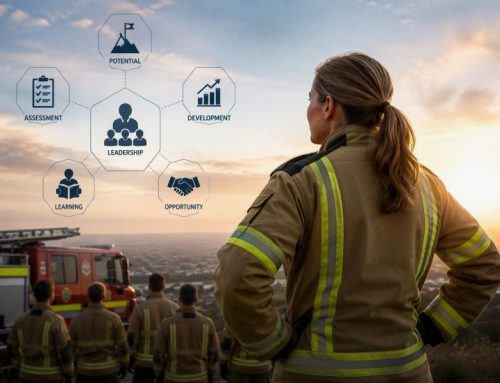
There’s no shortage of conversation in Fire and Rescue Services about leadership, behaviours, values and culture. There’s also plenty of agreement about what a “good” manager looks like. What is of more concern is how FRSs are choosing to evaluate those behaviours.
Many FRSs are using the NFCC Leadership Framework. But the exercises they’re using are often not evaluating behaviours. They’re assessing what candidates think, not what they’ll do. It’s a bit like passing a driving test on theory alone, without ever getting behind the wheel.
Give someone a topic, time to prepare, a presentation slot or a panel with questions, and of course they’re likely to produce something thoughtful. They’ll research the subject, structure their views and prepare their responses. There will be differences between candidates in both content and performance.
You’ll be able to assess things such as:
That might sound like a lot. In reality, it’s a fairly narrow range of evidence.
What candidates know versus what candidates do
When it comes to discussion, interview and presentation-style exercises, one of the biggest considerations is what you’re actually measuring. When candidates are asked questions as part of a promotion process, their first instinct is usually quite simple: “What do you want to hear?”
Questions such as:
…will tell you what somebody knows or what they think. They don’t necessarily tell you how they will behave. That’s an important distinction if you’re trying to assess leadership behaviours.
The value of job simulations
Now compare those “telling” assessments with a job simulation exercise. A job simulation puts candidates in situations where they’re required to do, not just say. The evidence you get is broader and richer. When candidates have limited time and are required to deal with tasks, problems and interactions, they use the skills they actually have, not the skills they can tell you they have. For example, an individual might need to have a difficult conversation or constructively manage conflict.
Seeing somebody do that is significantly more powerful and reliable than hearing how they might approach it, without having to factor in context or potential triggers.
Are your exercises really different?
I’m not suggesting there isn’t a place for pre-prepared answers, presentation slides and well-rehearsed thinking. There is. The question is whether that’s the only thing you’re assessing. It’s also worth asking whether exercises that have different names and slightly different formats are genuinely providing different evidence. A presentation, discussion or briefing may look different on paper. The more important question is whether they’re actually assessing different things, or simply measuring the same limited range of qualities in different ways.
What people say and what people do don’t always match
What we say and what we do won’t always be the same. That’s why job simulation exercises designed to elicit a range of criteria-based behaviours are so important. They provide properly informed, leadership-linked data on which to base decisions.
When you create space to observe real behaviour, you see both potential and developmental gaps.
Candidates deserve to have both evaluated properly so they can move forward effectively, whatever the outcome.
The question worth asking
So, are you promoting the best leaders, or rewarding the most confident communicators?
Can you prove it?